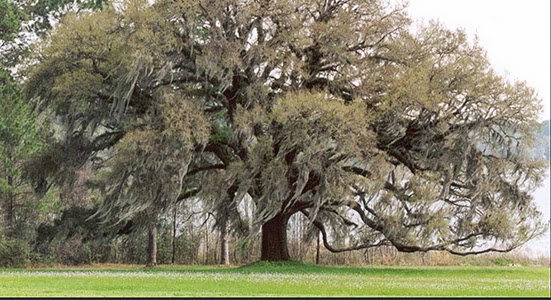
The first Wednesday of every month, our Junior Gardening Chair, Arlene Hendrickson, meets with youngsters at Julington Creek Elementary School. She never fails to entertain them, and they constantly surprise her with their earnest responses to her presentation. This month she recalled the folktale explaining what Spanish Moss is. The tale has a satirical edge to it, jesting that the beards of Spanish men are somewhat thin. No doubt if Spain had retained control of Florida, citizens would be calling it, "English Moss."
There are many folktales regarding Spanish Moss, but the one Arlene chose was particularly cute. It seems that a Spanish soldier named Pedro fell in love (or lust) with a young Indian maiden. Being a virtuous maiden she refused his advances and finally ran away. Pedro was a determined man and he pursued her with more vigor than skill. He ran too close to a live oak and his beard got tangled in the tree's branches. He was moving too quickly to stop, and didn't even notice his beard had been left hanging in the tree. The maiden was the more desperate and fleet-footed or the two and she escaped. It was only then that Pedro noticed his beard had been pulled off. He spent the rest of his life unsuccessfully searching for that beard, and died dejected and clean-shaven. The beard, however, fared much better than its owner. It thrived in the warm sunny climate and spread to the neighboring tree boughs. Today it is found on the mightiest trees and the lowliest shrub. But the question still remains, "Where is Pedro's original beard:" To this day it has never been found.
The school children found the tale of Pedro's beard fascinating and immediately volunteered to look for it. When Arlene told the children that the beard was not nearby, maybe as far away as Georgia, one little girl announced that she had an uncle in Georgia and that she would ask him to search the trees so he could tell her where Pedro's beard was.

As adults, we may be able to spot the fiction in a folktale, but we may not know much more about
Spanish moss other than it did NOT originate from a
Spaniard's beard. First, it is not a moss, but an epiphyte, which
means that it is not a parasite (contrary to popular misconception). Spanish moss has no roots. The beard-like stems are covered with small leaves for photosynthesis and tiny
silvery-gray scales that catch water and nutrients (in dust particles)
from the air. The flowers are inconspicuous,
pale green or blue, and fragrant at night. Spanish moss is a member of the bromeliads or "air plants."

It grows
where it does thanks to the birds that collect it for nesting material and thus disperse the seeds from the moss. The wind also blows the small seeds to another site. While Spanish moss does the tree
no harm, occasionally it can become so thick that it
shades
the leaves of its host, or, when heavy with rainwater, breaks a branch.
Before the invention of synthetic materials, Spanish moss was also used by humans to stuff furniture and pillows. It was even distilled for gin production. Nowadays, it is used by crafters for decorative pieces. Insects such as red bugs and chiggers also find it attractive, so be sure you debug it and remove any small animals living in it before use.
We'll let you know if Julington Creek Elementary locates Pedro's beard.


 We has a lot more fun at Mickey's than this photo implies! Mickey, Carolyn, Beverly, Linda, and Dianne were there the morning of 3/18. We discussed the horticultural needs of milkweed, the types of milkweed native to our area, possible locations on public and private lands to establish milkweed for monarchs, and initiation of a new North American Butterfly Association (NABA) butterfly monitoring circle to allow us and the public to start providing real data on butterfly counts. We'll be modelling our circle after the GTMNERR circle, and we appreciate their generous offer of assistance to us to get that started. We'll post more about our 4th of July Butterfly Count event as we get it together.